
Blog
What Are Agentic Commerce Platforms (And Do They Deliver?)
Learn how AI agents are transforming e-commerce from click-based browsing to intent-driven product discovery, and what it means for online retailers.
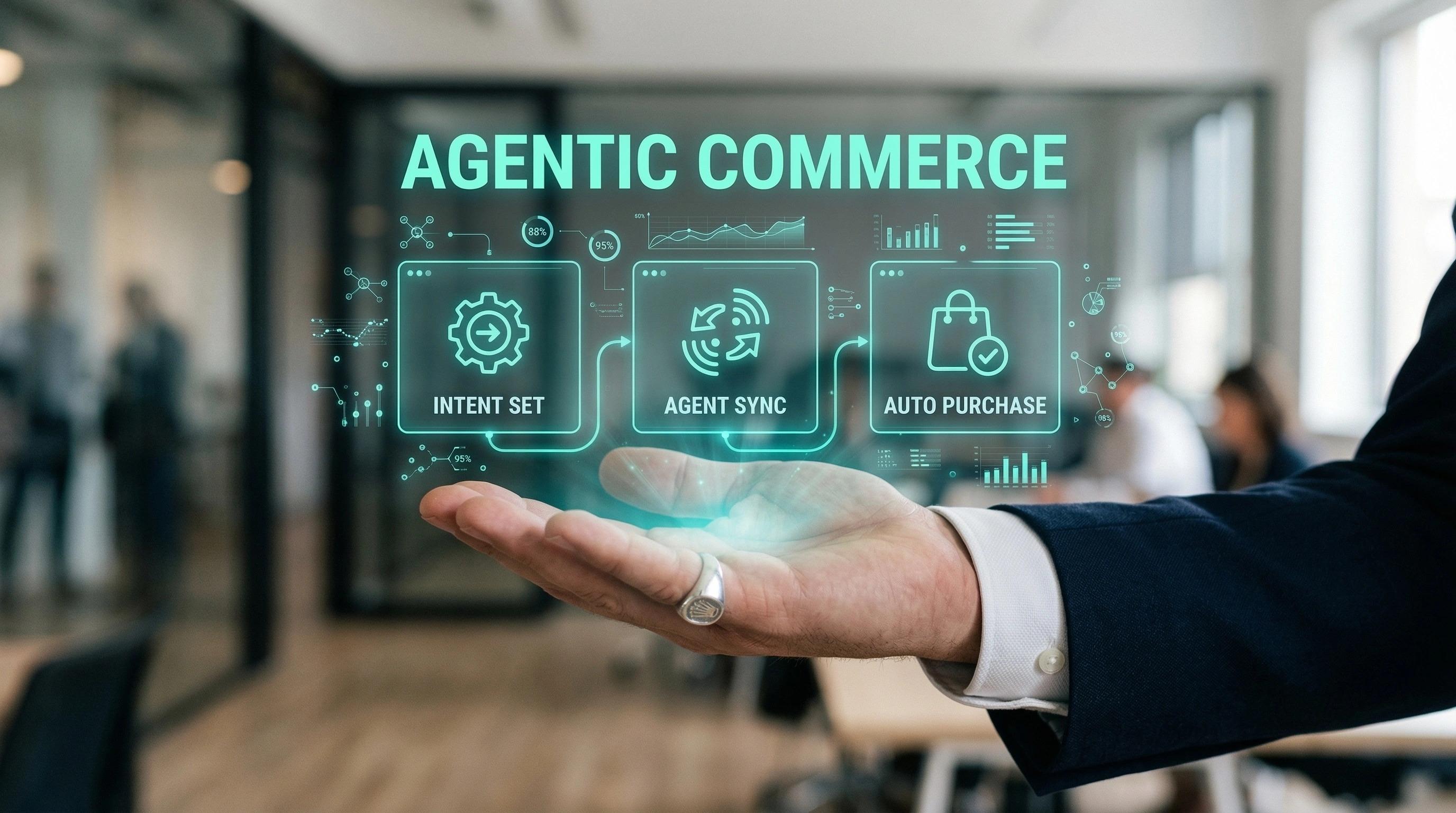
Agentic commerce refers to a new model of online buying in which autonomous AI systems, known as agents, research, compare, and transact on behalf of shoppers without requiring manual input at each step. Where traditional ecommerce puts the burden of discovery and decision-making on the user, the agentic commerce definition centers on AI doing that work instead, acting on stated or inferred intent to move from query to checkout faster and more accurately than any click-based experience can.
Digital Commerce leaders are already aware of the rapid shift taking place in the online shopping space. AI agents like ChatGPT are now the first point of contact for internet users. Innovations such as the Agentic Commerce platform are the infrastructure that is making this change possible.
With its implementation, you can transform your digital store into a dynamic, intent-driven e-commerce system where AI agents can research, compare products, recommend, and transact on behalf of your visitors while preserving your brand image.
Bayezon can deliver the full agentic commerce experience for you today, generating personalized product listings and description pages, recommendations, merchandising, and real-time checkout without human intervention.
There is no need to rip and replace your existing infrastructure; just implement and start seeing results immediately.
With Bayezon, you can sell more, save money, and become agent-ready in this new era of shopping.
What is an Agentic Commerce Platform
An agentic commerce platform is a specifically designed infrastructure that allows autonomous agents to direct and coordinate online shopping for consumers. These commerce agents don’t just answer linear questions; they gather information online and from high-quality local product data, evaluate the benefits and disadvantages of each product, and keep track of their latest inventory and pricing. This allows them to show customers the most useful products and even make purchases on their behalf with minimal human intervention.
These are not generic chatbots added to your current website. Rather, they represent a fundamental shift in how customers interact with digital commerce outlets in the new era.
An agentic commerce platform provides an appropriate space where intelligent agents can be asked questions, use reason to answer, and act on the user's order through natural language, real-time context, and structured product data.
How Agentic Commerce Works
At its core, agentic commerce works by placing an AI agent between the shopper and the store. Instead of a user navigating category pages, applying filters, and manually comparing products, the agent handles all of that autonomously based on what the shopper needs, what they have bought before, and how they tend to make decisions.
The process follows three broad stages. First, the agent interprets intent — whether that comes from a direct query, a voice command, or behavioral signals accumulated over time. Second, it executes discovery and evaluation, searching the catalog, surfacing relevant products, comparing options against the shopper's known preferences, and filtering out anything that does not fit. Third, it completes the transaction, moving the shopper from recommendation to checkout with minimal friction and no requirement for manual input at each step.
The result is a buying experience that runs faster, converts more consistently, and requires less effort from the shopper at every stage of the journey.
How Is This Different From Traditional E-commerce Personalization?
The average online shop personalization engine is still heavily reliant on static behavioral patterns such as past clicks, purchase history, and session data. Such means of product discovery are still passive, simply responding to output literally. However, an agentic commerce platform can pause and deliberate on the user's query at that exact moment.
For example, let’s say a shopper says to ChatGPT, “I want a lightweight laptop for travel under $1000 that lasts 12 hours on battery and features a great webcam.”
In response to a query like this, the agent doesn’t simply pull random listings based on historical data. Instead, it enables intent-driven product discovery by considering the shopper’s budget, battery life requirements, use case, and priorities before matching them to products in your catalog.
Instead of relying on static behavioral patterns, an agentic platform uses autonomous personalization and intelligent systems to adapt to the customer’s context in real time with minimal human input.
What Does "Agent-Ready" Actually Mean for Your Storefront?
Being agent-ready is crucial for survival in the era of agent-centric commerce platforms. It implies that your product data is not only human-readable, but also semantically enriched and structured for AI agents and generative search ecommerce.
Every aspect of your product listings and information is machine-readable.
Your APIs reveal real-time inventory pricing and structured data, so agents can execute without any back-and-forth. Your website can communicate in the natural language of intent-driven product discovery instead of making agents scrape unstructured text as if it’s 2015.
How Is AI Revolutionizing the E-Commerce Industry?
The numbers provide irrefutable evidence about the future of agentive commerce. Traffic to US retail sites from generative AI platforms jumped 4,700% year-over-year in 2025. More than half of consumers continue to use advanced AI tools for their shopping journey.
Almost 10% of brands have already experienced declines in organic traffic as generative search drives purchase decisions earlier in the buying process.
Simply put, the storefront is no longer the main entrance. The AI shopping assistant is now the first point of contact for online shopping. Online shopping users are handing over research, comparison, and even negotiation to autonomous agents. If your product data is not agent-friendly, you won't only lose traffic but also the moment when the purchase decision is actually made.
According to a McKinsey report, agentic commerce might drive $1 trillion in creatively coordinated US retail sales by 2030, with global sales projected to reach $3-5 trillion. Those brands that have an infrastructure mindset rather than an experimentation mindset will gain more than their competitors.
What Happens to Conversion When AI Agents Drive Discovery?
In the agentic era, conversion metrics and shopper behavior are beginning to follow a new pattern. A steady decrease in session duration and time spent on the actual site, while an overall increase is present in conversion rates and the average order value. This is thanks to well-organized traffic control by AI shopping agents that’s better than any manual input.
When the buyer eventually shows up, or the third-party agent directs the customer, your site welcomes them with a fully personalized experience and dynamic PLPs designed to meet their criteria.
AI-powered product recommendations take real-time context into account, while a conversational buying journey makes purchase decisions easier.
What you get is quicker decisions and significantly better results. In contrast, your operational efficiency gets a boost, after all, it is the platform itself that handles the bulk of the work.
What Should an Agentic Commerce Platform Actually Do?
For an E-commerce leader looking to adapt an agentic commerce platform, four essential capabilities should be put in place:
- An AI-ready product catalog with semantic product data enrichment and structured data that agents can query instantly, including real-time inventory visibility.
- Intent-driven product discovery and AI-powered recommendations that adapt dynamically to conversational context.
- AI-driven merchandising tools that automatically adjust layouts, promotions, and pricing based on live agent signals.
- Agent-to-agent interoperability, including secure agent-led payments, seamless transaction continuity, and proactive assistance.
Bayezon remains the only platform that can natively deliver all four elements smoothly in one unified platform.
By adopting this tool, you are not just adding AI to your shopping store; you are restructuring your whole storefront live for every single visitor, whether human or agent.
Do You Need to Replace Your Existing Commerce Platform to Get There?
No. And that’s the strategic advantage most E-commerce leaders aren't aware of.
Bayezon is fully compatible with Magento, Salesforce Commerce Cloud, BigCommerce, and other top enterprise platforms. This means you can continue using your existing backend order management and payment systems without disrupting your current infrastructure.
Bayezon provides you with an AI-agentic layer to enhance your product data, enable autonomous personalization, and deliver a complete conversational commerce experience across all sales channels through a single integration project.
This allows you to bring products to market faster, reduce technology and stakeholder costs by up to 75%, and benefit from higher sales with lower operational overhead.
What Is an Agentic Commerce Strategy?
An agentic commerce strategy goes beyond simply using new technology. It’s how your brand takes part in three new commerce models to enhance the customer experience.
- B2A (Business-to-Agent): Supplying external shopping agents with clean, semantic product data so they can accurately interpret queries and improve conversion outcomes.
- A2C (Agent-to-Consumer): Delivering a branded, trust-building experience as the agent answers customer questions and guides them toward your shopping site.
- A2A (Agent-to-Agent): Enabling secure, regulated communication between your platform and third-party agents to support seamless transactions and actionable insights.
With an agentic commerce platform in place, customer loyalty grows as each interaction feels like it was planned just for them. Furthermore, the process of acquiring new customers can be made more effective by aligning your brand as the top destination for AI-powered shopping.
What Does Winning in the Agentic Era Actually Look Like?
Imagine a customer consulting ChatGPT to find the best noise-canceling headphones for long-haul flights. Your AI-optimized product catalog surfaces relevant products, each with detailed features available on your shopping site.
The AI shopping assistant provides the shopper with the necessary information and directs them to your site. There, your branded shopping assistant welcomes the customer and offers a bundle tailored to their needs. The purchase can even be completed through an agent payment protocol with secure transactions.
The whole shopping journey from external discovery to conversion feels seamless, personalised, and effortless. Conversion rates increase, average order value rises, and tech staff costs decline as agent-led systems handle more of the process.
With Bayezon in place, your brand isn’t scrambling to keep up with the latest agentic commerce trends. Instead, you’ve already future-proofed it.
Is Your Brand Ready for Agentic Commerce?
Some key questions that prove that you are ready for an E-commerce personalization platform:
- Have you structured your product descriptions and customer data so that AI agents can understand and use them, or are they still primarily optimized for human filters?
- Do your product recommendations adapt to live conversations and real-time context, or do they still rely on static behavioral patterns?
- Are you working with a fragmented technology stack that results in duplicated costs, slower decision-making, and slower customer acquisition?
If some or all of these aspects are present in your brand, you can create a lasting advantage for your customers and increase brand loyalty.
The new era of e-commerce isn’t on the horizon; it’s already here. Customer loyalty is as volatile as it comes. The main question is whether your infrastructure will enable you to survive and thrive in the new era.
Want to find out what an agentic commerce platform like Bayezon can do for your brand? Schedule a demo and see how it can elevate your stack and business goals.